Description
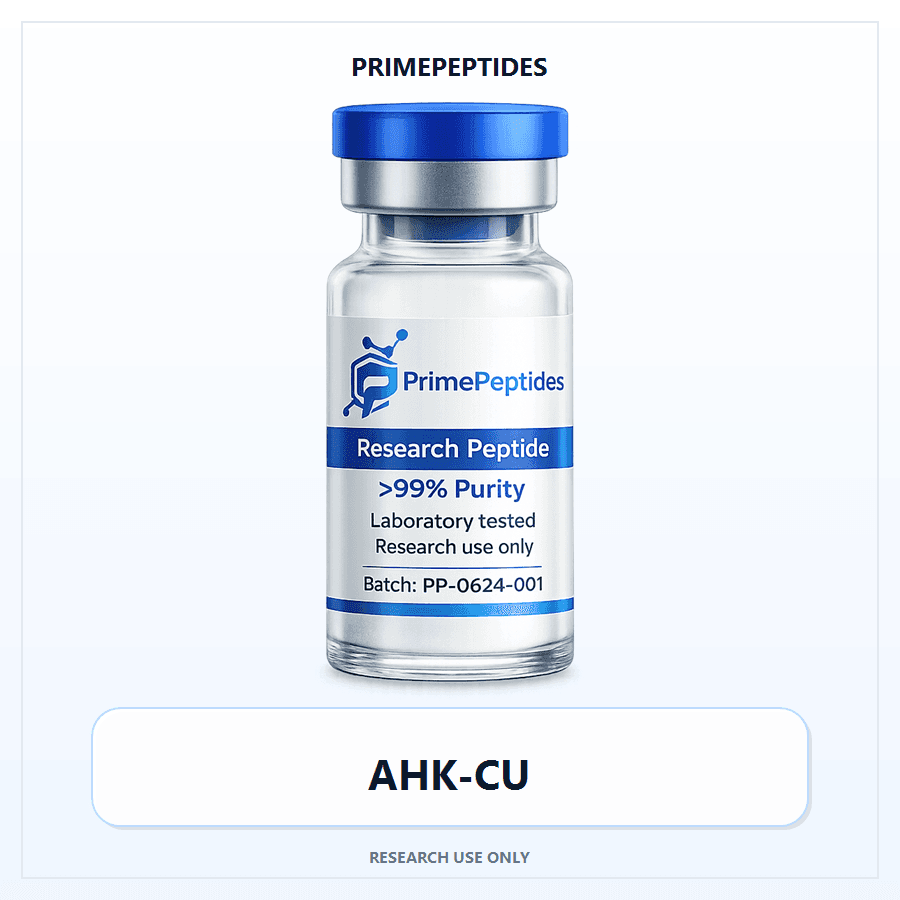
AHK-CU is listed in the PrimePeptides catalog as a research-use-only product for qualified laboratory customers. The catalog entry focuses on clear variant data, transparent pricing and documented certificates of analysis.
Technical details: Molecular formula: C₁₅H₂₄ClCuN₆O₄; Molecular weight: 451.39 g/mol; Sequence: Ala-His-Lys-Cu Peptides that bind to metal ions have drawn increasing interest in biomedical research because of their chemical flexibility and the range of biological effects they can trigger. Among them, the AHK-Cu peptide—a copper-complexed tripeptide—has stood out for its possible influence on cell signaling, tissue repair, and even disease modulation. What makes it intriguing isn’t just its composition but how its structure interacts with biological systems. AHK-Cu seems to bridge the gap between simple peptides and more complex bioactive molecules, showing activity in wound healing, anti-inflammatory regulation, and perhaps even neuroprotection. This paper takes a closer look at what’s currently known about AHK-Cu—its chemical makeup, the research that supports its potential, and how it might fit into future therapeutic strategies. While much of the enthusiasm around copper-peptide complexes is still based on early-stage findings, the promise they hold is difficult to ignore. Chemical Structure and Composition of AHK-Cu Peptide AHK-Cu is a tiny synthetic tripeptide that is made up of three amino acids: alanine (A), histidine (H), and lysine (K). It is held together by a copper(II) ion. The histidine residue in the middle does most of the work. Its imidazole ring creates a stable place for copper to bond, which holds the whole complex together. This arrangement affords AHK-Cu both shape and function. It can look like natural repair peptides and take part in redox reactions since copper can transfer electrons. It’s worth noting that the copper ion isn’t just along for the ride. It gives the molecule redox activity, meaning AHK-Cu can take part in oxidative and enzymatic processes linked to cellular stress and repair. In that sense, the peptide’s design is quite deliberate: the tripeptide chain stabilizes copper while preventing excessive reactivity or toxicity. Similar copper-peptide frameworks have been studied for their stability and compatibility with living systems [3]. The peptide backbone protects the copper center and still allows it to interact selectively with biological targets. This combination of safety and reactivity makes AHK-Cu a compelling structure for further therapeutic development. Research and Clinical Studies Research directly focused on AHK-Cu remains somewhat limited, but it benefits from decades of work on copper-peptide chemistry in general. Many insights come from studies exploring how metal–organic complexes interact with cells—how they enter them, what redox states they adopt, and how they influence signaling pathways. For instance, investigations into functionalized two-dimensional materials for therapeutic use emphasize that careful chemical optimization can greatly affect biological interactions [3]. Those principles carry over neatly to peptides like AHK-Cu, where stability and compatibility under physiological conditions are critical. In another line of research, scientists studying photothermal and hyperthermic therapies have looked at how materials transfer heat and energy through tissues [4]. Although AHK-Cu isn’t an inorganic nanomaterial, it faces similar questions: How does it distribute in the body? How long does it stay active? And can it deliver benefits without unintended toxicity? Its strong copper coordination is thought to improve its pharmacokinetic profile by allowing slow, localized action rather than broad systemic exposure. These studies together suggest a framework for understanding AHK-Cu—not as an isolated molecule, but as part of a broader family of metal–peptide therapeutics that interact dynamically with living systems. Potential Therapeutic Applications The possible medical uses of AHK-Cu are diverse, and the science behind them is still taking shape. One of the best-supported areas is wound healing. Because copper complexes are known to promote fibroblast growth, collagen formation, and angiogenesis, AHK-Cu may accelerate the body’s natural repair process. It also seems to act as an antioxidant, limiting the oxidative stress that typically slows tissue recovery. Another emerging interest is its effect on inflammation. Copper plays a role in immune regulation, and delivering it through a peptide carrier could fine-tune inflammatory responses more safely than direct metal exposure. Some researchers have drawn parallels between this controlled biochemical modulation and how photothermal agents deliver targeted heat to specific tissues [3]. Additionally, there is some discussion regarding the neuroprotective potential of AHK-Cu. For the creation of neurotransmitters and the upkeep of neurons, copper is a crucial component of brain chemistry. Theoretically, a stable complex such as AHK-Cu could help or restore copper balance in neurological conditions, but this is still a theoretical concept that needs much more research before using in clinical settings. Future Directions and Emerging Research The next stage of AHK-Cu research will probably combine materials science, computer modeling, and chemistry. Linking AHK-Cu to bigger, biocompatible carriers that enhance delivery accuracy and shield it from deterioration is one intriguing approach, drawing inspiration from recent developments in nanomaterial-based treatments (Saha et al., 2024). Computer simulations may also be able to show how the molecule acts in actual biological settings, providing hints for bettering its efficacy and design. Techniques used in unrelated fields may prove surprisingly useful here. For instance, high-throughput systems originally built to measure cavitation effects on materials [2] could be adapted to study how AHK-Cu interacts with tissues on a microscale—helping identify which structural tweaks lead to better results. Still, the real test will come in clinical settings. Before AHK-Cu can move from the lab to medical practice, researchers need clearer data on its metabolism, safety, and possible off-target interactions. Lessons learned from other bioengineered materials, such as magnetic beads and gene network applications [1][4], highlight the importance of a cross-disciplinary approach. Chemistry alone won’t be enough; biology and engineering must both weigh in. Conclusion When combined with critical metals, basic peptide structures like AHK-Cu can become potent medicinal agents. This is an intriguing example. It has a solid basis for more research because of its stability, antioxidant activity, and biological significance. It’s still early days, though, and many presumptions regarding its safety, distribution, and long-term consequences require thorough evaluation. AHK-Cu may potentially become a member of the expanding family of copper-based therapies targeted at neuronal preservation, inflammation reduction, and regeneration if research keeps moving forward in the same direction, combining computational discoveries with useful biomedical testing. Although there is still much to prove, it is currently a fascinating possibility with a lot of scientific momentum. References Avino-Diaz, M. A. (2006). Special homomorphisms between probabilistic gene regulatory networks. arXiv preprint arXiv:math/0603291. http://arxiv.org/pdf/math/0603291v1 Bell, D. G., Hopcroft, M. A., & Behnke-Parks, W. M. (2018). High-throughput, semi-autonomous measurement of cavitation-mediated material breakage. arXiv preprint arXiv:1812.05576. http://arxiv.org/pdf/1812.05576v1 Saha, S., Sur, A., Saha, L., & Alam, M. K. (2024). Investigating the optical and thermodynamic properties of 2D MoGe 2 P 4 : Potential material for photothermal therapy. arXiv preprint arXiv:2502.14239. http://arxiv.org/pdf/2502.14239v1 Singh, V., & Banerjee, V. (2012). Hysteresis in a magnetic bead and its applications. arXiv preprint arXiv:1208.5347. http://arxiv.org/pdf/1208.5347v1; Purity: 99%.
PrimePeptides shop variants: AU50 - 50mg x 10 vials, AU100 - 100mg x 10 vials.
No separate report link was found on UtherPeptide for this product..
Technical data
- Purity: 99%
- Variant: AU50 - 50mg x 10 vials, AU100 - 100mg x 10 vials
- Stock: 20
- Research Use Only: Yes
Purity, HPLC & COA
AHK-CU is cataloged with a focus on documented purity, clear batch data and COA references. Relevant quality details such as HPLC purity, storage notes and variant information are shown transparently.
Research use
For laboratory research only. AHK-CU is not intended for human consumption, injection, diagnostic use, therapeutic use or any other non-research purpose.
Storage
- Store dry, cool and protected from light.
- Avoid temperature fluctuations and follow internal laboratory procedures.
- Archive report/COA documentation internally after receipt.
Disclaimer
This product is intended for research use only. Buyers are responsible for compliance with local regulations.
Shipping & Payment
Orders are prepared after bank transfer payment receipt. Bank details are shown after checkout.
Frequently asked questions
What is AHK-CU intended for?
AHK-CU is intended strictly for research-use-only laboratory work and not for human consumption.
Which variants are available?
Available variants: AU50 - 50mg x 10 vials (100,00 €), AU100 - 100mg x 10 vials (140,00 €).
How is quality documented?
PrimePeptides focuses on purity, COA documentation, HPLC context and clear batch-level product data.